
The Reserve Bank of India (RBI) on Friday kept the key repo rate unchanged at 4 per cent in view of rising inflation and faint signs of economic growth amid the gradual lifting of coronavirus related countrywide lockdown.
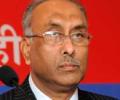
Mundra fills the vacancy created by the retirement of KC Chakrabarty in April, two months before his five-year tenure was come to an end.

Given that food inflation remains high, the inflation outlook will be influenced by concerted efforts to break food inflation persistence.

An alumina of Delhi School of Economics, from where she secured a Master's in Economics, Thorat joined the central bank way back in 1972.

At a time when the government is nudging the private sector to ramp up its capital expenditure (capex), the Ministry of Statistics and Programme Implementation (MoSPI) is poised to kick-start the first-of-its-kind annual survey on the status of private sector capex from next month. "The inaugural edition of the annual exercise will start in October and will be completed by December. "The results will be made public by February next year," said Geeta Singh Rathore, director general, National Sample Survey Office (NSSO), at a data users' conference on Thursday.

RBI Governor would like to wait till Budget before taking any action on rate front.

RBI wants periodic revision of the pensions for its retired employees.

Defending the rate hike announced on Friday, he said short-term growth could be scarified for long-term growth. "Absolutely, we will raise rates even before the policy dates if inflation goes up. The RBI governor is continuously watching the situation. Unproductive demand has to be curtailed. It is up to banks to increase the rates, but RBI is giving the signal that there is a need for rates to go up if you have to anchor inflationary expectations," Chakrabarty said after an
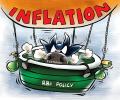
The RBI on Friday retained inflation forecast for FY23 at 6.7 per cent amid uncertain price trajectory on "geopolitical shocks" and on hope that inflationary pressures would ease with pick-up in kharif sowing and supply chain improvements. In its previous monetary policy review in June, it had projected retail inflation for 2022-23 at 6.7 per cent, higher from 5.7 per cent forecast in April. The six-member Monetary Policy Committee (MPC) unanimously decided to raise the benchmark repo rate by a steep 50 basis points to 5.40 per cent with immediate effect to tame inflation while supporting growth.

The Reserve Bank of India's rate-setting panel on Wednesday started discussions to firm up the next bi-monthly monetary policy amid expectations that it might retain status quo on interest rate but change its monetary policy stance amid rising inflation on account of geopolitical developments.
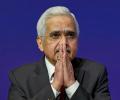
The highlights of RBI's bi-monthly monetary policy announced by Governor Shaktikanta Das:
The report further noted that inflation is expected to fall to 4.5 per cent by quarter ended March 2017.
The Reserve Bank of India will encourage banks to set up a payment corporation to streamline payment system.

Government's focus on infrastructure is the biggest positive for the Indian economy, followed by the improvement in tax collections and good consumption recovery.
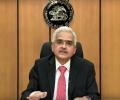
The RBI on Friday said it will give banks Rs 1 trillion through targeted long-term repo operations (TLTROs), of up to three-year maturity, to deploy in "investment-grade corporate bonds, commercial paper, and non-convertible debentures over and above the outstanding level of their investments in these bonds as of March 27, 2020."

In 2023-2024, 95 scheduled commercial banks received over 10 million complaints from their customers. The process of KYC at many banks has become 'HYC' -- harass your customer, points out Tamal Bandyopadhyay.

Nominating Das, the Banker magazine, which announced the award, said India's banks have faced a series of challenges, from non-performing loans to issues around fraud. Faced with these challenges, Shaktikanta Das has taken steps to bring banking in India up to standard via a restrained approach to governance.

Reserve Bank Governor Shaktikanta Das on Thursday said the fundamental drivers of the Indian economy are gaining momentum and the country is moving on a sustainable growth path. In the inaugural address at FIBAC 2024, the governor said that massive changes are taking shape in various economic sectors and markets, and the country is geared for orbital shifts.
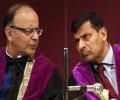
"Finance Ministry and RBI keep talking all the time," Rajan said.
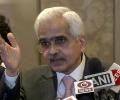
Reserve Bank Governor Shaktikanta Das on Wednesday said the decision to tweak policy rates was not in his hand as he himself is driven by the situation on the ground. In April, the Reserve Bank in a surprise move hit the pause button and decided to keep the key benchmark policy rate at 6.5 per cent. Prior to it, the Reserve Bank of India (RBI) was on a rate hiking spree, raising the repo rate by 250 basis points since May 2022.

Tata Steel was the top gainer in the Sensex pack, climbing 2.11 per cent, followed by Infosys, HDFC Bank, HDFC, Kotak Bank, M&M and PowerGrid. NSE Nifty jumped 142.05 points to end at 17,605.85.

India is not reaping the benefits of demographic dividends, former RBI governor Raghuram Rajan said on Tuesday, emphasising that there is a need to focus on improving the human capital and enhancing their skill sets. "I think we are in the midst of it (demographic dividend), but the problem is we are not reaping the benefits," Rajan said at a conference on "Making India an Advanced Economy by 2047: What Will it Take" at the George Washington University in Washington DC. "That's why I said 6 per cent growth.
The Reserve Bank of India Governor D Subbarao has exhorted the apex bank's staff in his New Year message to convert present crisis into an opportunity, while maintaining that the crisis will be deeper and prolonged.
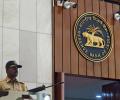
The Reserve Bank (RBI) resisted a 'raid' planned by some in the government to extract Rs 2-3 lakh crore from its balance sheet in 2018 to meet populist spending in run-up to general elections, Viral Acharya, who was deputy governor at RBI at that time, has written.

Reserve Bank of India (RBI) is unlikely to cut the benchmark interest rate at its upcoming monetary policy review meeting, taking place soon after the announcement of the Lok Sabha election results, amid inflation challenges, said experts. The Monetary Policy Committee (MPC) may also refrain from rate cut as economic growth is picking up, notwithstanding the elevated interest rate of 6.5 per cent (repo) prevailing since February 2023. The meeting of the Reserve Bank Governor Shaktikanta Das headed MPC is scheduled for June 5 to 7.
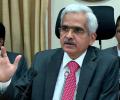
All-out efforts are needed to mitigate the adverse impact of the Covid-19 pandemic, and the RBI will use any instrument necessary to revive growth and preserve financial stability, according to the minutes of the central bank's policy meeting.
RBI may also be open to injecting liquidity through open market purchases of bonds but is resisting relaxing capital buffers for banks.
Banks will ask the banking regulator to defer the higher provisioning norms on standard restructured advances.

Reserve Bank of India (RBI) Governor Duvvuri Subbarao said inflation would determine the future policy and the effort would be to manage the balance between growth and inflation.

The MPC states that the 4 external members will have a tenure of four years each.

Finance minister Pranab Mukherjee said on Tuesday the Reserve Bank of India's move to keep almost all rates unchanged is line with the discussions he had with the apex bank's governor and the government's thinking on fiscal and monetary policies.

The Reserve Bank of India (RBI) on Wednesday announced an extension of interim ways and means advances (WMAs) limit of Rs 51,560 crore to state governments till September, to help them tide over the financial stress posed by the second wave of COVID-19. WMAs are temporary advances given by the RBI to the states to tide over any mismatch in receipts and payments. There are two types of WMA - normal and special. While normal WMA are clean advances, special WMA are secured advances provided against the pledge of the government of India dated securities.
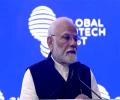
He said the transformation brought about by the fintech sector in India is not just limited to technology, but its social impact is far-reaching. He also stressed that fintech has dented the parallel economy and is bridging the gap between villages and cities on the financial services front. The prime minister also said that in the last 10 years, the fintech space has attracted investments of more than $31 billion and fintech startups have grown by 500 per cent.
The RBI is not statutorily independent from the government but has long enjoyed wide latitude
RBI Governor D Subbarao is expected in the capital on Friday to hold pre-policy consultations with Finance Ministry officials.

An article on 'State of the Economy' in the monthly Bulletin also said the improvement in the outlook for agriculture and the revival of rural spending have turned out to be the bright spots in the evolution of demand conditions. Consumer price inflation ticked up in June 2024 after three consecutive months of moderation as a broad flare-up in vegetable prices halted the overall disinflation that had been underway, it said.
The government is weighing the option of creating the post of a fourth Deputy Governor in the Reserve Bank of India to oversee activities of the co-operative banking sector, which has seen a series of scams in the last two years.
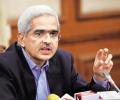
A staunch defender of demonetisation, it would be interesting to see how he handles the government's increasing demand for more cash from the RBI, and letting some weak banks get out of prompt corrective action.

'Investors can consider staying invested in long duration products as there is a possibility of rate cuts in the near term.' Positive macros - lower inflation, high forex reserves and favourable demand-supply dynamics for government bonds - make a strong case for rate cuts from December, says Devang Shah, head of fixed income, Axis Mutual Fund. In an interview with Abhishek Kumar in Mumbai, Shah says this view may not hold true if commodity prices go up sharply.
